
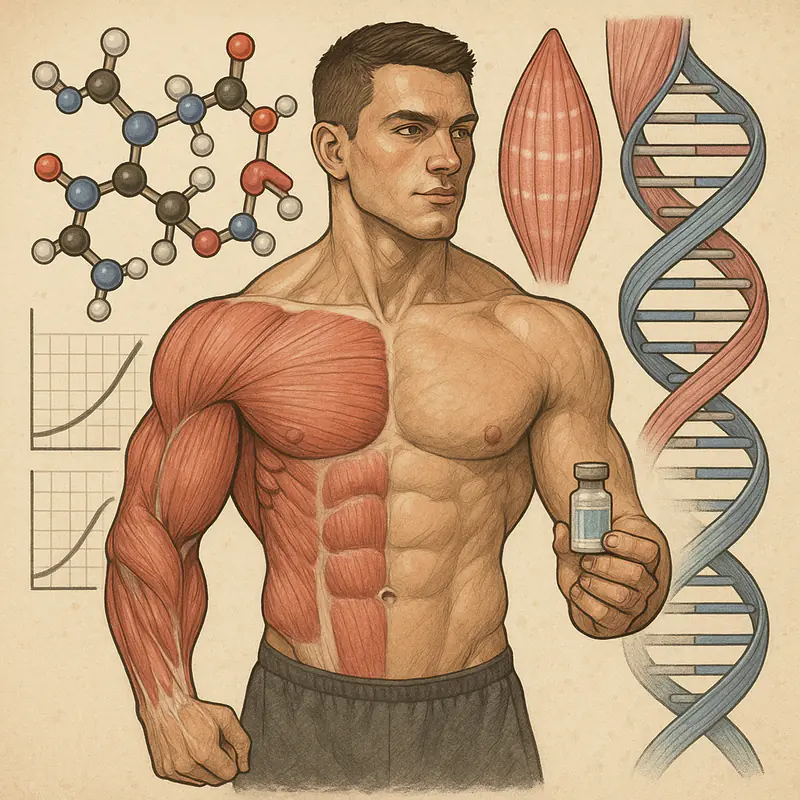
Why Peptide Stacking Matters for Aesthetic Physique Development
The looksmaxxing pursuit of peak physical appearance isn't just about losing weight or adding muscle in isolation. It's about achieving simultaneous body recomposition — the reduction of body fat, particularly visceral and abdominal fat, alongside preservation and development of lean muscle mass in a way that maximizes visual definition, facial sharpness, and structural aesthetics.
Standard caloric approaches force a choice: cut calories and lose fat while risking muscle breakdown, or eat for muscle growth while adding fat. Peptide research has identified compounds that may allow researchers to attack both goals in parallel by operating through distinct biological mechanisms — the hormonal axis, adipose receptor pathways, mitochondrial metabolism, and visceral-specific lipolysis — simultaneously.
This guide covers the most extensively researched peptides for body recomposition in the looksmaxxing context: CJC-1295 + Ipamorelin, AOD-9604, Tesamorelin, MOTS-c, and Fragment 176-191. All of these are research compounds not approved by the FDA for human use in performance or aesthetic contexts, and all should be approached with appropriate medical supervision and understanding of the evidence base.
CJC-1295 + Ipamorelin: The Growth Hormone Secretagogue Foundation
Growth hormone is one of the body's most powerful endogenous regulators of body composition. It drives lipolysis (fat breakdown), supports protein synthesis, thickens the dermis, and improves recovery from training. The problem with exogenous growth hormone administration is its blunt pharmacological profile — supraphysiological GH flooding that disrupts feedback systems and carries well-documented risks.
CJC-1295 and Ipamorelin offer an alternative by stimulating the pituitary gland to release its own GH in a pattern that more closely mimics youthful physiology. CJC-1295 is a GHRH (growth hormone releasing hormone) analog. Its C-terminal amidation confers resistance to DPP-IV enzymatic degradation, extending its activity window. It amplifies GH pulse amplitude throughout the day, maintaining sustained lipolytic signaling.
Ipamorelin is a ghrelin receptor agonist — a ghrelin mimetic — that triggers clean, selective GH release without the cortisol elevation, prolactin increase, or appetite stimulation seen with older GHRP compounds. It creates distinct GH pulses that generate maximal anabolic signaling around training windows and pre-sleep.
The combination is synergistic by design. CJC-1295 maintains the hormonal foundation; Ipamorelin creates the spikes. Human studies confirm both compounds demonstrably increase circulating GH and IGF-1 — the downstream mediator responsible for muscle protein synthesis. The pulsatile pattern appears critical: it's the pulse structure of youthful GH secretion that correlates with body composition advantages, not continuous elevation.
For looksmaxxers, the downstream effects most relevant to aesthetics include: reduced visceral and subcutaneous fat (particularly abdominal, where GH lipolytic signaling is most potent), improved skin thickness and collagen density through direct dermal fibroblast stimulation, enhanced training recovery enabling higher volume, and significant improvements in sleep architecture — GH is predominantly released during slow-wave sleep and the relationship is bidirectional.
AOD-9604: Selective Adipose Receptor-Level Lipolysis
AOD-9604 is the C-terminal fragment of human growth hormone — specifically amino acids 177 to 191 — engineered to retain hGH's lipolytic properties without stimulating IGF-1 production or disrupting glucose metabolism. This metabolic selectivity is its defining characteristic and the reason it occupies a unique position in body recomposition stacks.
Its mechanism operates at the cellular level within adipose tissue. AOD-9604 specifically activates beta-3 adrenergic receptors (β3-AR) found predominantly in visceral and abdominal fat depots. This triggers a cAMP cascade through adenylyl cyclase, activating Protein Kinase A, which in turn phosphorylates hormone-sensitive lipase (HSL) and adipose triglyceride lipase (ATGL) — the enzymes that break down stored triglycerides into free fatty acids for systemic energy use.
Simultaneously, AOD-9604 inhibits lipogenesis, creating a dual-direction pressure on fat cell size. Animal research demonstrated over 50% reduction in weight gain compared to controls over a 19-day period, with genetic knockout experiments confirming β3-AR pathway dependency. In obese models, AOD-9604 increased β3-AR RNA expression to levels comparable with lean animals — addressing the blunted lipolytic capacity of obese adipose tissue at the receptor level.
Six human clinical trials involving over 900 participants documented excellent tolerability. However, the final Phase IIb trial failed to show statistical significance versus placebo when combined with structured diet and exercise intervention — a finding worth noting honestly. Whether this reflects efficacy ceiling, desensitization, or the particular context of tightly controlled dietary environments is debated in the research community. Those exploring AOD-9604's application often consult resources like Peptidesgetonline for current supplier comparisons and purity documentation.
Tesamorelin: The Only Peptide With Visceral Fat RCT Evidence
Of all the body recomposition peptides available to researchers, Tesamorelin has the most rigorous human evidence base. A GHRH analog (GHRH 1-44 with C-terminal amidation) distinct from CJC-1295, Tesamorelin has been through randomized controlled trials that document specific visceral adipose tissue (VAT) reduction with statistical significance.
The landmark NEJM study in 2007 showed daily Tesamorelin for 26 weeks reduced VAT by 10.9% (approximately 21 cm²) versus 0.6% in placebo. Subsequent trials confirmed 15–20% visceral fat reduction over the same period, with improvements in lipid profiles and — critically for aesthetic applications — significant increases in total muscle density across all four truncal muscle groups. This means reduced muscle fat content and improved lean muscle area, not just overall weight changes.
More recent data demonstrated Tesamorelin reduced hepatic (liver) fat content by nearly 5% versus placebo — a metabolic health benefit with downstream aesthetic implications through improved insulin sensitivity and reduced abdominal distension.
From an aesthetic standpoint, visceral fat reduction achieves something subcutaneous fat loss cannot: it addresses the abdominal protrusion that persists even at low body fat percentages due to organ-surrounding fat. This is why Tesamorelin is specifically valued in advanced physique protocols for its capacity to sharpen abdominal definition and improve the visual waist-to-hip ratio independent of total body weight changes.
MOTS-c: Mitochondrial Metabolic Signaling and Myostatin Inhibition
MOTS-c (mitochondrial open reading frame of the 12S rRNA-c) represents a fundamentally different category of peptide. It's a 16-amino acid mitochondrial-encoded peptide — a "mitokine" that signals from mitochondria to regulate systemic metabolism. It is naturally upregulated in response to exercise, functioning as a downstream molecular signal of training-induced adaptation.
Its mechanism centers on AMPK activation — AMP-activated protein kinase, the master metabolic switch that activates fat oxidation and mitochondrial biogenesis while suppressing lipogenesis. This makes MOTS-c a metabolic-level compliment to the hormonal-level effects of CJC-1295 and Ipamorelin, operating through an entirely independent pathway.
The most relevant finding for looksmaxxers is MOTS-c's myostatin inhibition. In mice on high-fat diets, MOTS-c treatment produced a 40% reduction in systemic and tissue-specific myostatin levels compared to controls by elevating AKT phosphorylation and inhibiting FOXO1 — an upstream transcription factor for muscle wasting genes. This anti-catabolic specificity is unique among the compounds in this class: MOTS-c appears to actively protect lean muscle mass during periods of caloric deficit or metabolic stress when muscle catabolism would otherwise accelerate.
Post-exercise MOTS-c levels in human subjects have been significantly associated with reductions in fat mass, body weight, insulin resistance markers, and inflammation — and with increases in lean mass independent of total weight changes. The compound essentially amplifies the metabolic benefits of training, operating through the same pathways exercise activates.
Fragment 176-191: Pure Lipolysis Without Anabolic Side Effects
Fragment 176-191 is the 15-amino acid C-terminal segment of human growth hormone responsible specifically for its fat-mobilizing effects. Through structure-activity relationship research, scientists isolated this fragment from hGH's growth-promoting domains, creating a compound that targets fat oxidation pathways without triggering IGF-1 synthesis or the diabetogenic activity associated with full-length hGH.
Its mechanism mirrors AOD-9604 at the cellular level — adenylate cyclase activation, cAMP elevation, HSL and ATGL phosphorylation, triglyceride hydrolysis — while simultaneously reducing lipogenesis. The absence of IGF-1 induction means it doesn't trigger the growth signals that can reduce insulin sensitivity or promote excessive anabolic activity, making it theoretically compatible with caloric deficit protocols where metabolic selectivity is paramount.
A 2004 clinical trial found the lowest daily dose (1 mg) most effective for fat metabolism stimulation — counterintuitively suggesting that less aggressive dosing may produce cleaner lipolytic signaling without triggering regulatory compensation. Human evidence remains limited to small trials, but the mechanistic profile makes Fragment 176-191 a logical addition to comprehensive fat loss stacks targeting simultaneous recomposition.
The looksmaxxing community's growing interest in body composition peptides is well-documented at Peptides Looksmaxxing, which covers compound comparisons, research protocols, and the increasingly nuanced understanding of how these compounds interact with training, nutrition, and sleep optimization for maximum aesthetic outcomes.
Stacking Logic: Four Independent Biological Levels
The reason peptide stacking for body recomposition produces outcomes that individual compounds cannot replicate is that each peptide operates at a distinct biological level:
- Hormonal axis (Level 1): CJC-1295 + Ipamorelin elevate systemic GH and IGF-1, driving anabolic signaling and lipolytic tone throughout the day
- Adipose receptor level (Level 2): AOD-9604 and Fragment 176-191 activate β3-adrenergic receptors directly in fat cells, triggering enzymatic lipid breakdown independent of hormonal signals
- Mitochondrial metabolic level (Level 3): MOTS-c activates AMPK and inhibits myostatin, amplifying fat oxidation and protecting lean mass during deficit phases
- Visceral-specific level (Level 4): Tesamorelin preferentially targets visceral adipose tissue through superior VAT receptor sensitivity to GHRH signaling
Each compound plugs into a different node of the body composition regulatory network. No single compound or non-peptide approach touches all four simultaneously. This layered targeting is why researchers report body recomposition velocity from comprehensive stacks that exceeds what any individual compound achieves alone.
Research Timelines and Realistic Expectations
Based on published human data and community protocols, body composition changes from peptide stacking typically emerge in phases. The first two to four weeks show primarily functional improvements: enhanced sleep quality, accelerated training recovery, improved energy regulation, and reduced post-training soreness. These reflect neurological and hormonal adaptation rather than tissue changes.
Weeks three through six begin showing visible fat distribution changes — typically first apparent in the midsection and face, where GH lipolytic signaling and visceral fat reduction are most pronounced. Training performance improvements become measurable.
By weeks eight to twelve, meaningful body composition shifts are documented: reduced abdominal circumference, improved muscle definition at equivalent body weight, and the characteristic "sharper" facial appearance associated with visceral fat reduction. For cycle protocols (typically 10–12 weeks on, 4 weeks off), this window represents the target outcome period.
Compound sourcing quality at this level of protocol sophistication is non-negotiable. Researchers serious about valid data and consistent outcomes rely on verified suppliers — details on compound specifications and third-party testing are compiled at Clavtides for cross-reference during protocol planning.
Critical Context: What the Evidence Actually Supports
Intellectual rigor in peptide research requires acknowledging the gap between mechanism and confirmed human outcome. CJC-1295 and Ipamorelin demonstrably increase GH and IGF-1 in human subjects — that's established. Tesamorelin's visceral fat reduction is RCT-confirmed. AOD-9604's safety across 900+ subjects is documented. MOTS-c's myostatin inhibition is confirmed in animal models.
What remains largely in the anecdotal and community-protocol domain: the combined body recomposition outcomes from stacking these compounds in healthy, training individuals. Large-scale RCTs of these combinations don't exist. Individual genetics, training quality, nutritional adherence, and sleep hygiene likely determine outcomes as much as or more than any peptide protocol.
None of these compounds are FDA-approved for aesthetic, body composition, or performance applications. Long-term stacking safety data in healthy individuals is absent. These are research-grade compounds that require medical supervision, comprehensive baseline bloodwork, and ongoing monitoring. Approached with that rigor, the body recomposition peptide stack represents a scientifically coherent frontier in appearance optimization — but it remains a frontier, not an established treatment.